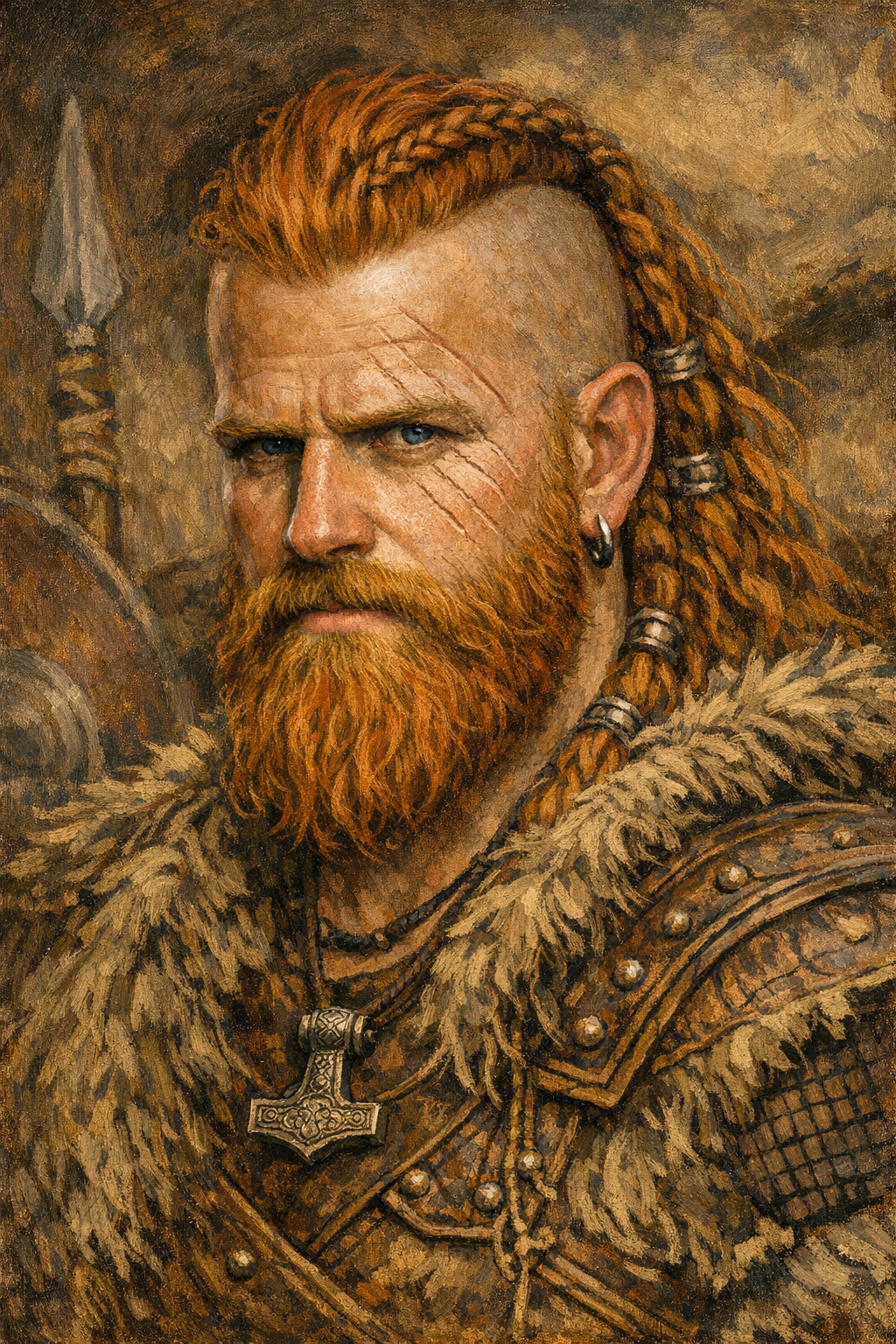
Bjǫrnar Tengdur’s tale begins in the far, wind gnawed north, where the Sea of Thassa breaks itself endlessly against the cliffs of Torvaldsland. Among the longhouses of the Tengdur bloodline, he was always the quiet one—broad shouldered, soot stained, and deliberate. While others boasted of raids or wrestled for sport, Bjǫrnar shaped iron. His hammer spoke for him: steady, patient, unyielding.
In Torvaldsland they called him The Quiet Hammer, half in jest, half in respect. He rarely raised his voice, but when he did, men listened. And when he lifted his hammer—whether over an anvil or an enemy—there was no mistaking the strength behind it. The Call South. Word reached Torvaldsland on a cold spring morning: Alaric Tengdur, Bjǫrnar’s cousin and Jarl of Clan Tengdur in Teletus, had fallen. Some said treachery. Others said sickness. All agreed on one thing—without a strong hand, the clan’s foothold in the south would crumble. Bjǫrnar did not hesitate. He quenched his hammer in snow, packed his tools, and boarded a longship bound for the warmer winds of the south. The voyage was long, and the men who sailed with him expected a smith, not a leader. But storms reveal character. When a squall nearly split the mast, it was Bjǫrnar who lashed it together. When pirates tested their hull, it was Bjǫrnar who stepped forward first, hammer in hand, calm as winter stone. By the time they reached Teletus, the crew already followed him like a Jarl.
Taking the Mantle
Teletus was a different world—sun baked stone, bustling markets, and politics as sharp as any blade. Clan Tengdur had grown soft under Alarc’s final months. Rivals circled like sleen. Merchants withheld tribute. Even the warriors muttered about abandoning the southern claim. Bjǫrnar walked into the clan hall without ceremony. He placed his hammer on the central table—iron scarred, handle wrapped in sealskin—and said only: “I am Tengdur. I will lead.”
No roar. No threat. Just certainty.
Some challenged him. They learned quickly that a blacksmith’s arms are not merely for swinging tools. Bjǫrnar fought with the same economy he lived by—no wasted motion, no flourish, only decisive, crushing blows. When the dust settled, none doubted him again.
The Quiet Hammer’s Rule
Under Bjǫrnar, Clan Tengdur hardened. He rebuilt the forges, trained warriors in the discipline of the anvil—heat, strike, temper. He forged new axes for the shield wall, new chains for the docks, and new alliances with the wary Teletan houses. But he never forgot the north. He spoke often of Torvaldsland’s cold purity, its honor, its storms. And slowly, the clan remembered its roots. The southern sun had softened them; Bjǫrnar’s leadership reforged them.
Return to Torvaldsburg
When the clan was strong again—wealthy, disciplined, feared—Bjǫrnar made his final decree.
They would return home.
The longships sailed north under the Tengdur banner, their hulls heavy with southern silver and their warriors eager for the familiar bite of northern wind. Bjǫrnar stood at the prow, hammer at his belt, watching the cliffs of Torvaldsburg rise from the mist. The villagers welcomed them with awe. A clan once thought lost had returned stronger than ever, led by a man who spoke little but accomplished much. Bjǫrnar Tengdur, The Quiet Hammer, became Jarl not by birthright alone, but by the weight of his deeds—each one struck like a blow on the world’s great anvil. If you want, I can expand this into a saga style chapter, a character dossier, a heraldic seal variant for Bjǫrnar, or even weave him into the broader Tengdur lineage you’ve been building. Continue the story leaving Torvaldsburg and settling in Selnar, on the Isle of Cos Bjǫrnar Tengdur’s return to Torvaldsburg should have been the end of a saga—clan restored, honor reclaimed, the north once again echoing with the strength of the Tengdur name. But men like Bjǫrnar are not forged for stillness. The anvil cools if left untouched, and so does a warrior’s purpose. What came next was not exile, nor ambition, but a calling shaped by the shifting tides of Gor.
The Leaving of Torvaldsburg
Torvaldsburg welcomed Clan Tengdur with feasting, song, and the thunder of shields against longhouse beams. Yet beneath the celebration, Bjǫrnar sensed a truth: the north had changed in his absence, and so had he. He had lived too long under southern suns, learned too much of trade, diplomacy, and the subtle blades of politics. The north was honest, but it was also rigid. Some Jarls whispered that Bjǫrnar had become “too Teletan,” while others feared his growing influence. Bjǫrnar did not argue. He simply listened—quiet as always—and when the time came, he gathered his closest warriors and said: “The clan must grow, not rust. We sail again.” There was no rebellion, no bitterness. Only the understanding that the Tengdur line was meant to expand, not merely return.
Southward Once More
The longships cut through the Thassa like dark arrows. Bjǫrnar stood at the prow, the salt wind tugging at his beard, his hammer resting against his hip. This time, he did not sail for Teletus. That chapter had been forged and quenched. He sailed for Cos. Rumors had reached him of opportunity—of islands rich with trade, of cities hungry for strong hands and stronger leadership. And among those islands, one name surfaced again and again: Selnar. A settlement on the Isle of Cos, small but strategically placed, with a harbor deep enough for longships and a population caught between Cosian authority and local independence. A place where a man of iron could shape something new.
Arrival at Selnar
Selnar was unlike both Torvaldsland and Teletus. White washed stone houses clung to the hillsides, olive trees twisted in the warm breeze, and the harbor bustled with fishermen, traders, and mercenaries. The people were wary—Cosians trusted slowly—but they recognized strength when they saw it. Bjǫrnar did not arrive as a conqueror. He arrived as a craftsman. He built a forge first, not a hall. The ringing of his hammer became the heartbeat of Selnar. Warriors came to him for blades. Farmers came for tools. Shipwrights came for nails and rivets. And with each piece of iron he shaped, he shaped the respect of the town. They began calling him The Quiet Hammer of Selnar.